
Toyota Tacoma (2005–2015) Owners Manual: Rear seats (Access Cab and Double Cab models)
 Access Cab models
The bottom cushion of the rear seats can be raised and lowered.
■ Before raising the bottom cushion
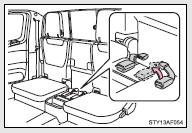
Stow the seat belt buckles.
This prevents the seat belt buckles from falling out when you fold the seatback.
■ Raising the bottom cushion
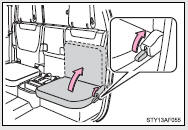
Raise the bottom cushion up while pulling the lever until it locks.
■ Lowering the bottom cushion
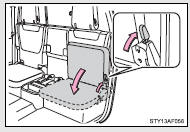
Push the bottom cushion down while pulling the lever until the bottom cushion locks into the seat position.
 Double Cab models
The seatback of the rear seat can be folded.
■ Before folding rear seats
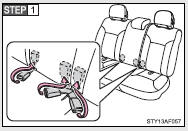
Stow the rear seat belt buckles.
This prevents the seat belt buckles from falling out when you fold the seatback.
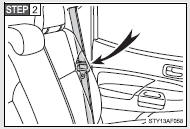
Pass the seat belts through the seat belt hangers.
This prevents the shoulder belt from being damaged.
Make sure that the seat belts are removed from the hangers before using them.
■ Folding rear seats
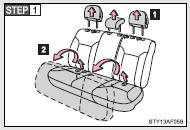
 Remove the head restraint
 Swing the bottom cushion up by pulling
the lock release strap
Swing the bottom cushion up by pulling
the lock release strap
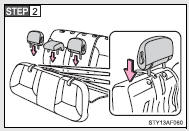
Attach the head restraints to the holders located on the back sides of the bottom cushions.
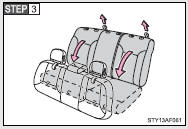
Fold down the seatback by pulling the lock release strap.
■Waterproof and water-repellent seats (if equipped)
Waterproof and water-repellent seats are installed in your vehicle; however, the water-repellent effect does not last forever.
CAUTION
■When the seatback is folded/the bottom cushion is raised
Do not sit on or place anything on the seatback or auxiliary box while driving.
■When returning the seats to their original position
Observe the following precautions. Failure to do so may result in death or serious injury.
●Be careful not to get your hands or feet pinched in the seat.
●Make sure the seatbacks and bottom cushions are securely locked. Failure to do so will prevent the seat belt from operating properly.
●Check that the seat belts are not twisted or caught under the seat.
●Arrange the seat belts in the proper positions for ready use.
NOTICE
■Before folding the seats
The seat belts buckles must be stowed.
 Active head restraints (Access Cab and Double Cab models only)
When the occupant’s back presses against the seatback during a rear-end collision,
the head restraint moves slightly forward to help reduce the risk of whiplash on
the seat occupant.
■A ...
 Head restraints
Head restraints are provided for all seats.
■ Adjusting the head restraints
Bench type front seat
Up
Pull the head restraints up.
Down
Push the head restraint down while pushing the l ...
Other materials:
Precaution
PRECAUTION
1. IGNITION SWITCH EXPRESSION
(a) The type of ignition switch used on this model differs depending on the specifications
of the vehicle. The expressions listed in the table below are used in this section.
Expression
Ignition Switch (Position)
Engine S ...
Front Airbag Sensor LH Circuit Malfunction (B1615/14)
DESCRIPTION
The front airbag sensor LH consists of parts such as the diagnostic circuit and
the frontal detection sensor.
When the airbag sensor assembly receives signals from the frontal deceleration
sensor, it determines whether or not the SRS should be activated.
DTC B1615/14 is set when a ...
Disassembly
DISASSEMBLY
PROCEDURE
1. REMOVE INTAKE VALVE
(a) Using SST, compress the inner compression spring and remove the valve
spring retainer locks.
SST: 09202-70020
SST: 09202-00021
09202-01010
09202-01020
(b) Remove the valve s ...
