
Toyota Tacoma (2005–2015) Owners Manual: Head restraints
Head restraints are provided for all seats.
■ Adjusting the head restraints
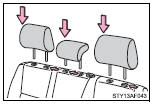
 Bench type front seat
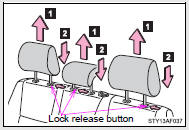
 Up
Up
Pull the head restraints up.
 Down
Down
Push the head restraint down while pushing the lock release button.
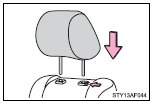
 Separated type front seat
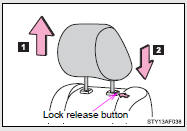
 Up
Up
Pull the head restraints up.
 Down
Down
Push the head restraint down while pushing the lock release button.
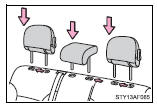
 Rear seat (Double Cab models only)
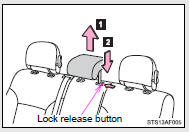
 Up
Up
Pull the head restraints up.
 Down
Down
Push the head restraint down while pushing the lock release button.
■ When using the rear head restraints
 Access Cab models
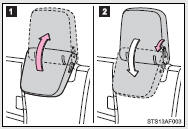
 To use
Lift up the head restraint until it locks.
 To fold
Pull the head restraint lock release lever to fold the head restraint.
 Double Cab models
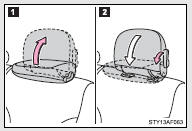
 To use
Lift up the head restraint until it locks.
 To fold
Pull the head restraint lock release lever to fold the head restraint.
■Removing the front head restraints
 Bench type seat
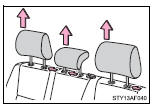
Pull the head restraint up while pushing the lock release button.
Separated type seat
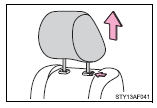
Pull the head restraint up while pushing the lock release button.
■Removing the rear head restraints (Double Cab models only)
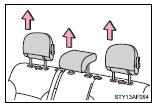
Pull the head restraint up while pushing the lock release button.
■Installing the front head restraints
Bench type seat
Align the head restraint with the installation holes and push it down to the lock position.
Press and hold the lock release button when lowering the head restraint.
Separated type seat
Align the head restraint with the installation holes and push it down to the lock position.
Press and hold the lock release button when lowering the head restraint.
■Installing the rear head restraints (Double Cab models only)
Align the head restraint with the installation holes and push it down to the lock position.
Press and hold the lock release button when lowering the head restraint.
■When installed the rear outboard head restraints to opposite direction (Double Cab models only)
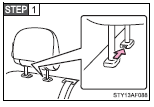
Push a flathead screwdriver into the slot.
The slot is located on the left side of the right head restraint anchor.
 While pressing in the screwdriver,
pull up the head restraint.
While pressing in the screwdriver,
pull up the head restraint.
■Adjusting the height of the head restraints
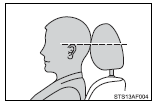
Make sure that the head restraints are adjusted so that the center of the head restraint is closest to the top of your ears.
■Adjusting the front center seat (Bench type seat) and rear center seat head restraints (Double Cab models)
Always raise the head restraint one level from the stowed position when using.
CAUTION
■Head restraint precautions
Observe the following precautions regarding the head restraints. Failure to do so may result in death or serious injury.
●Use the head restraints designed for each respective seat.
●Adjust the head restraints to the correct position at all times.
●After adjusting the head restraints, push down on them and make sure they are locked in position.
●Do not drive with the head restraints removed.
 Rear seats (Access Cab and Double Cab models)
Access Cab models
The bottom cushion of the rear seats can be raised and lowered.
■ Before raising the bottom cushion
Stow the seat belt buckles.
This prevents the seat belt buckles from f ...
 Seat belts
Make sure that all occupants are wearing their seat belts before driving the
vehicle.
■ Correct use of the seat belts
● Extend the shoulder belt so that it comes fully over the shoul ...
Other materials:
IG Signal Circuit
DESCRIPTION
This circuit detects whether the ignition switch is ON or off, and sends this
information to the main body ECU (multiplex network body ECU).
WIRING DIAGRAM
CAUTION / NOTICE / HINT
NOTICE:
Inspect the fuses for circuits related to this system before performing
the fol ...
TRAC OFF Indicator Light Remains ON
DESCRIPTION
In 2WD mode:
Operation of the VSC OFF switch changes the vehicle between normal mode,
TRAC OFF mode (AUTO LSD mode) and VSC OFF mode. During normal mode, pressing
the VSC OFF switch for a short amount of time changes the vehicle to TRAC
OFF mode (AUTO LSD mode), TR ...
Route cannot be Calculated
PROCEDURE
1.
SET DESTINATION
(a) Set another destination and check if the system can calculate the route correctly.
OK:
Route can be correctly calculated.
OK
NORMAL OPERATION
NG
PROCEED TO NEXT SUSPECTED AREA SHOWN ...
