INSTALLATION
CAUTION / NOTICE / HINT
NOTICE:
If the millimeter wave radar sensor assembly has been struck or dropped, replace the millimeter wave radar sensor assembly with a new one.
PROCEDURE
1. INSTALL MILLIMETER WAVE RADAR SENSOR ASSEMBLY
|
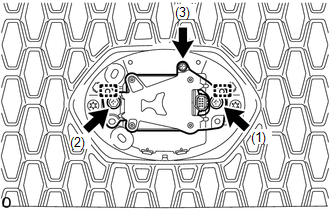
(a) for Type A: (1) Engage the 2 guides. (2) Temporarily install the millimeter wave radar sensor assembly with the 2 bolts and screw. (3) Tighten the 2 bolts and screw in the order shown in the illustration. Torque: Bolt : 2.5 N·m {25 kgf·cm, 22 in·lbf} |
|
|
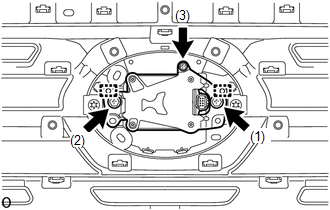
(b) for Type B: (1) Engage the 2 guides. (2) Temporarily install the millimeter wave radar sensor assembly with the 2 bolts and screw. (3) Tighten the 2 bolts and screw in the order shown in the illustration. Torque: Bolt : 2.5 N·m {25 kgf·cm, 22 in·lbf} |
|
|
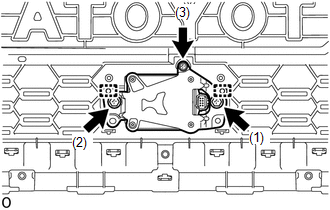
(c) for Type C: (1) Engage the 2 guides. (2) Temporarily install the millimeter wave radar sensor assembly with the 2 bolts and screw. (3) Tighten the 2 bolts and screw in the order shown in the illustration. Torque: Bolt : 2.5 N·m {25 kgf·cm, 22 in·lbf} |
|
2. INSTALL MILLIMETER WAVE RADAR WIRE
|
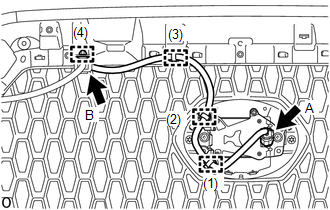
(a) for Type A: (1) Connect the connector A. (2) Engage the 4 clamps to install the millimeter wave radar wire in the order shown in the illustration. (3) Connect the connector B. |
|
|
(b) for Type B: (1) Connect the connector A. (2) Engage the 4 clamps to install the millimeter wave radar wire in the order shown in the illustration. (3) Connect the connector B. |
|
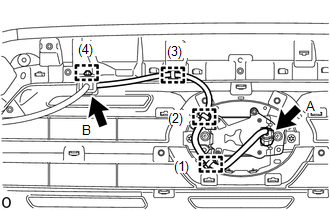
|
(c) for Type C: (1) Connect the connector A. (2) Engage the 5 clamps to install the millimeter wave radar wire in the order shown in the illustration. (3) Connect the connector B. |
|
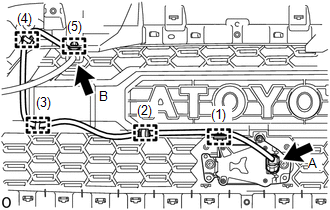
3. ADJUST MILLIMETER WAVE RADAR SENSOR ASSEMBLY
(a) When the millimeter wave radar sensor assembly is replaced, adjust the millimeter wave radar sensor assembly.
Click here .gif)