
Toyota Tacoma (2015-2018) Service Manual: Steering Angle Sensor Output Malfunction (C1434)
DESCRIPTION
Steering angle sensor signals are input to the skid control ECU (brake actuator assembly) via the CAN communication system.
HINT:
When a malfunction occurs in the communication line to the steering angle sensor, U0126 is output. If a DTC related to the CAN communication line is output, first troubleshoot the CAN communication line.
DTCs may be stored if one of the following occurs:
- Steering angle sensor zero point malfunction
- Steering angle sensor signal malfunction
|
DTC No. |
Detection Item |
DTC Detection Condition |
Trouble Area |
|---|---|---|---|
|
C1434 |
Steering Angle Sensor Output Malfunction |
Normal communication between the skid control ECU and the steering angle sensor and abnormal steering angle sensor zero point. |
|
WIRING DIAGRAM
Refer to DTC C1432 (See page .gif) ).
).
CAUTION / NOTICE / HINT
NOTICE:
- Do not remove the steering angle sensor from the spiral cable with sensor sub-assembly.
- When replacing the steering angle sensor (spiral cable with sensor sub-assembly), confirm that the replacement part is of the correct specification.
- Inspect the fuses for circuits related to this system before performing the following inspection procedure.
HINT:
- When U0073, U0124 and/or U0126 is output together with C1434, inspect
and repair the trouble areas indicated by U0073, U0124 and/or U0126 first
(See page ).
- When any of the speed sensors or the yaw rate and acceleration sensor (airbag sensor assembly) has trouble, DTCs for the steering angle sensor (spiral cable with sensor sub-assembly) may be output even when the steering angle sensor (spiral cable with sensor sub-assembly) is normal. When DTCs for the speed sensors or yaw rate and acceleration sensor (airbag sensor assembly) are output together with DTCs for the steering angle sensor (spiral cable with sensor sub-assembly), inspect and repair the speed sensor and yaw rate and acceleration sensor (airbag sensor assembly) first, and then inspect and repair the steering angle sensor (spiral cable with sensor sub-assembly).
PROCEDURE
|
1. |
CHECK DTC |
(a) Clear the DTCs (See page
).
(b) Turn the ignition switch off.
(c) Turn the ignition switch to ON again and check that no CAN communication
system DTC is output (See page
).
(d) Start the engine.
(e) Drive the vehicle at a speed of 35 km/h (22 mph) and turn the steering wheel
to the right and left to check that no speed sensor or yaw rate and acceleration
sensor DTCs are output (See page
).
HINT:
- If there is a malfunction in any of the speed sensors or the yaw rate and acceleration sensor (airbag sensor assembly), an abnormal value may be output although the steering angle sensor (spiral cable with sensor sub-assembly) sensor is normal.
- If speed sensor and yaw rate and acceleration sensor (airbag sensor assembly) DTCs are output simultaneously, repair these two sensors first and inspect the steering angle sensor (spiral cable with sensor sub-assembly).
|
Result |
Proceed to |
|---|---|
|
No CAN communication system, speed sensor, or yaw rate and acceleration sensor DTCs are output |
A |
|
CAN communication system DTC is output |
B |
|
Speed sensor or yaw rate and acceleration sensor DTC is output |
C |
| B | .gif) |
CHECK CAN COMMUNICATION SYSTEM |
| C | |
REPAIR CIRCUIT INDICATED BY OUTPUT DTC |
|
.gif)
|
2. |
CHECK TERMINAL VOLTAGE (BAT TERMINAL) |
(a) Turn the ignition switch off.
(b) Remove the steering wheel and the column cover lower (See page
).
|
(c) Make sure that there is no looseness at the locking part and the connecting part of the connectors. |
|
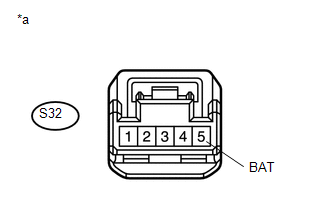
(d) Disconnect the S32 steering angle sensor (spiral cable with sensor sub-assembly) connector.
(e) Measure the voltage according to the value(s) in the table below.
Standard Voltage:
|
Tester Connection |
Switch Condition |
Specified Condition |
|---|---|---|
|
S32-5 (BAT) - Body ground |
Always |
11 to 14 V |
|
*a |
Front view of wire harness connector (to Steering Angle Sensor [Spiral Cable with Sensor Sub-assembly]) |
| NG | |
REPAIR OR REPLACE HARNESS OR CONNECTOR (BAT CIRCUIT) |
|
|
3. |
CHECK TERMINAL VOLTAGE (IG TERMINAL) |
(a) Turn the ignition switch to ON.
|
(b) Measure the voltage according to the value(s) in the table below. Standard Voltage:
|
|
.png)
| NG | |
REPAIR OR REPLACE HARNESS OR CONNECTOR (IG CIRCUIT) |
|
|
4. |
CHECK HARNESS AND CONNECTOR (ESS TERMINAL) |
(a) Turn the ignition switch off.
|
(b) Measure the resistance according to the value(s) in the table below. Standard Resistance:
HINT: If troubleshooting has been carried out according to the Problem Symptoms
Table, refer back to the table and proceed to the next step (See page
|
|
.png)
| OK | |
REPLACE SPIRAL CABLE WITH SENSOR SUB-ASSEMBLY |
| NG | |
REPAIR OR REPLACE HARNESS OR CONNECTOR (ESS CIRCUIT) |
 Steering Angle Sensor Internal Circuit (C1433)
DESCRIPTION
The skid control ECU (brake actuator assembly) outputs this DTC when it receives
an internal malfunction signal from the steering angle sensor.
DTC No.
Detection ...
 Yaw Rate Sensor Malfunction (C1436)
DESCRIPTION
The skid control ECU (brake actuator assembly) receives signals from the yaw
rate and acceleration sensor (airbag sensor assembly) via the CAN communication
system.
The airbag sensor ...
Other materials:
Diagnostic Trouble Code Chart
DIAGNOSTIC TROUBLE CODE CHART
HINT:
If a trouble code is displayed during the DTC check, inspect the trouble areas
listed for that code. For details of the code, refer to the "See page" below.
Seat Heater System
DTC Code
Detection Item
See page
...
Front Axle Hub Bolt
Installation
INSTALLATION
PROCEDURE
1. INSTALL FRONT AXLE HUB BOLT
(a) Install a new hub bolt through the axle hub.
(b) Install the washer plate, as shown in the illustration, through the hub bolt,
and install the hub bolt by tightening the hub nut.
2. INSTALL FRONT DISC
3. INSTALL FRON ...
Terminals Of Ecu
TERMINALS OF ECU
1. CHECK SLIDING ROOF ECU (SLIDING ROOF DRIVE GEAR SUB-ASSEMBLY)
(a) Disconnect the S50 sliding roof ECU (sliding roof drive gear sub-assembly)
connector.
(b) Measure the resistance and voltage according to the value(s) in the table
below.
HINT:
Measure the values on the ...
