
Toyota Tacoma (2005–2015) Owners Manual: Luggage compartment features
 Behind the rear seat (Double
Cab models only)
Behind the rear seat (Double
Cab models only)
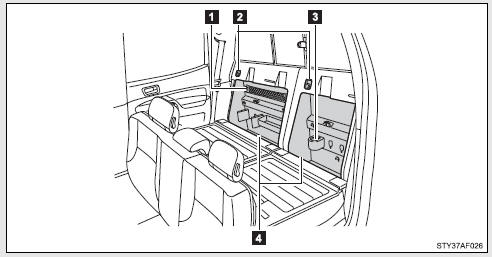
1.Cargo net hooks (vehicles with sub woofer)
2.
Grocery bag hooks
3.Flashlight holder
4.Storage boxes
 Deck
Deck
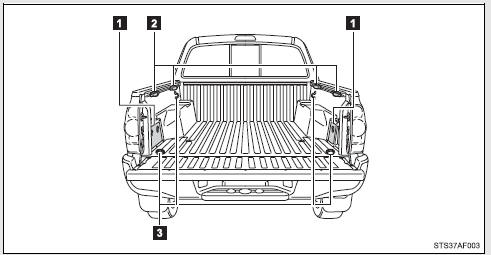
1. Auxiliary boxes
2. Tie-down cleats
3. Deck hooks
Auxiliary boxes
 Left side
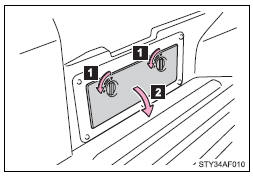
1. Turn the knob counterclockwise.
2. Open the lid.
 Right side (vehicles without 120V
power outlet)
Right side (vehicles without 120V
power outlet)
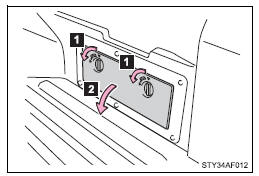
1. Turn the knob counterclockwise.
2. Open the lid.
Right side (vehicles with 120V
power outlet)
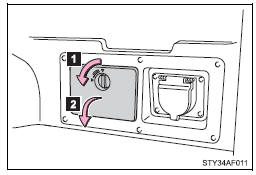
1. Turn the knob counterclockwise.
2. Open the lid.
CAUTION
■Caution while driving
Keep the auxiliary boxes closed and locked.
Injuries may result in the event of an accident or sudden braking.
Deck hooks
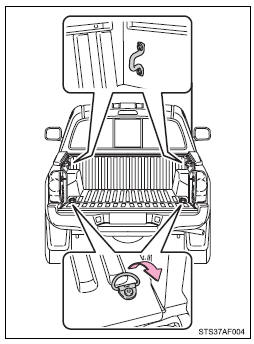
Deck hooks are provided for securing loose items.
CAUTION
■When not in use
Keep the deck hooks folded.
Tie-down cleats
The deck rail system enables you to insert and move tie-down cleats to their best location along deck rails to secure a load.
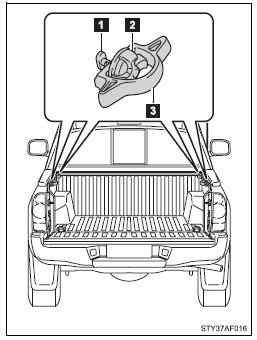
1. Locking plate
2. Thumb wheel
3. Tie-down cleat
■ Installing the tie-down cleat
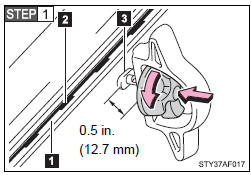
Loosen the thumb wheel in a counterclockwise motion, and depress the wheel so that the locking plate maintains 0.5 in.
(12.7 mm) gap.
1. Deck rail
2. Detent
3. Locking plate
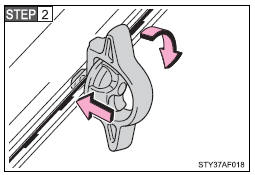
Insert the locking plate into the deck rail, rotate the tie-down cleat 90°, and release the thumb wheel.
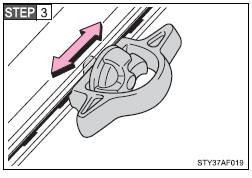
Slide the cleat to the closest detent in the rail system. You will feel that the locking plate snaps into a detent.
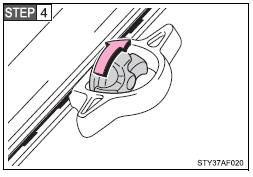
Tighten the thumb wheel in a clockwise motion until the clutch mechanism ratchets.
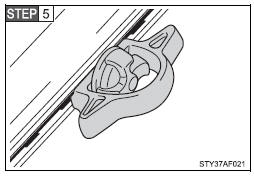
Check the tie-down cleat to confirm that it is locked into a detent and securely mounted to the deck rail system.
CAUTION
■Tie-down cleat precautions
●Properly install and tighten the tie-down cleats into the deck rail system.
Failure to properly install and tighten the tie-down cleats can cause cargo to become unsecured. Unsecured cargo can cause injury when the vehicle is in motion.
●Properly secure all cargo to prevent shifting or sliding during driving.
Failure to properly secure cargo can cause injury when the vehicle is in motion.
●Applying loads at an angle to the tie-down cleat greater than 45° or loads greater than 220 lb. (100 kg) may cause damage to the deck, deck rail system, tie-down cleat and/or the cargo.
●Do not exceed a total tensile load of 440 lb. (200 kg) per deck rail.
●Do not install more than the following number of tie-down cleats per deck rail: • Side rail:
Short deck—Max. 3 locations
Long deck—Max. 4 locations
• Headboard rail: Max. 3 locations
Storage boxes (Double Cab models only)
Storage box is designed to place things like bottles.
 Right side (vehicles without sub
woofer)
Right side (vehicles without sub
woofer)
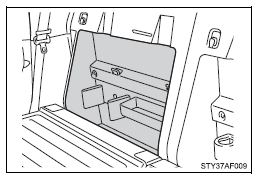
 Left side
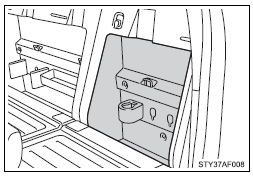
■Removing the separator
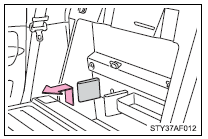
Remove the separator.
It can be installed in various positions as required.
Flashlight holder (Double Cab models only)
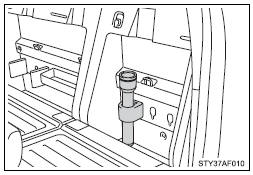
Flashlight holder is designed to hold the flashlight securely.
■Removing the flashlight holder
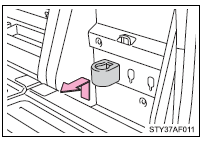
Remove the flashlight holder.
It can be installed in various positions as required.
Grocery bag hooks ( Double Cab models only)
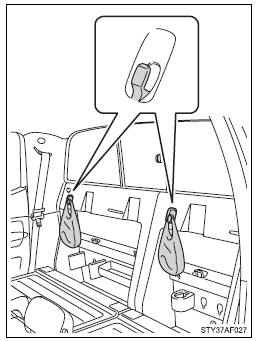
Grocery bag hook is designed to hang things like grocery bag.
NOTICE
■Grocery bag hook weight capacity
Do not hang any object heavier than 7 lb. (3 kg) on the grocery bag hooks.
Cargo net hooks (Double Cab models with sub woofer)
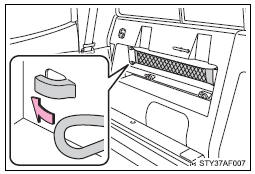
Cargo net hooks are designed to hang the factory-supplied cargo net.
NOTICE
■To prevent damage to the cargo net hook
Do not hang items other than the cargo net.
 Floor mat
Use only floor mats designed specifically for vehicles of the same model and
model year as your vehicle. Fix them securely in place onto the carpet.
Insert the retaining hooks (clips) into the f ...
 Garage door opener
The garage door opener can be trained to operate garage doors, gates, entry
doors, door locks, home lighting systems, security systems, and other devices.
The garage door opener (HomeLink® Univers ...
Other materials:
Installation
INSTALLATION
CAUTION / NOTICE / HINT
CAUTION:
Some of these service operations affect the SRS airbag system. Read
the precautionary notices concerning the SRS airbag system before servicing
(See page ).
If the side airbag was deployed, replace the front seat assembly with
...
Lost Communication With ECM/PCM "A" Missing Message (U010087,U010487,U012287)
DESCRIPTION
The ECM communicates with each sensor and ECU via CAN communication.
If any malfunction is detected in a CAN communication circuit, one or more CAN
communication system DTCs are stored.
DTC No.
Detection Item
DTC Detection Condition
Troubl ...
On-vehicle Inspection
ON-VEHICLE INSPECTION
PROCEDURE
1. INSPECT DRIVER SEAT BELT WARNING LIGHT
HINT:
The seat belt warning light on the combination meter assembly is used for both
the driver seat and front passenger seat.
(a) Turn the ignition switch to ON.
(b) When the driver seat belt is not fastened, check th ...
