
Toyota Tacoma (2015-2018) Service Manual: On-vehicle Inspection
ON-VEHICLE INSPECTION
PROCEDURE
1. INSPECT FOR COOLANT LEAK
HINT:
- The sliding surface inside the engine water pump assembly is lubricated by engine coolant. As some engine coolant is discharged during normal operation, engine coolant residue (solids) may be found on the drain plug or the bottom of the engine water pump assembly. Also, engine coolant may leak if foreign matter enters the engine water pump assembly, however the sealing performance will recover when the foreign matter is pushed out or breaks into fine pieces. In this case, check the area around the engine water pump assembly.
- Before performing this inspection, check that there are no engine coolant leaks from any parts other than the engine water pump assembly. If there are leaks, inspect those areas first.
- Perform this inspection when the engine is cold.
(a) Visually check the engine water pump assembly.
(1) Check that engine coolant is not dripping from the engine water pump assembly.
HINT:
- If engine coolant is dripping, replace the engine water pump assembly.
- If engine coolant is not dripping, perform the following check.
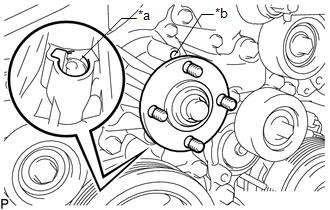
(b) Inspect the area around the engine water pump assembly.
HINT:
Check for deposits around the drain plug of the engine water pump assembly.
(1) Remove the fan pulley (See page .gif) ).
).
|
(2) Press a piece of thin paper towel against the drain plug or deposits on the lip of the drain plug and check that the paper towel is not wet. Text in Illustration
HINT:
|
|
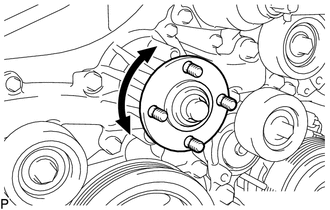
2. INSPECT ENGINE WATER PUMP ASSEMBLY
|
(a) Turn the pulley and check that the water pump bearing moves smoothly and quietly. If necessary, replace the engine water pump assembly. |
|
(b) Install the fan pulley (See page ).
3. INSPECT FLUID COUPLING ASSEMBLY
(a) Remove the fan with fluid coupling assembly (See page
).
|
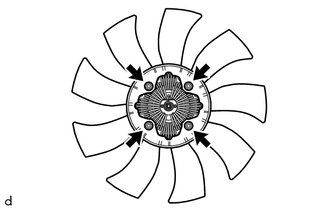
(b) Remove the 4 nuts and fan from the fluid coupling assembly. |
|
|
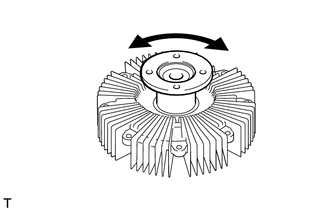
(c) Check that the fluid coupling assembly is not damaged and that no silicon oil leaks. If necessary, replace the fluid coupling assembly. |
|
(d) Install the fan to the fluid coupling assembly with the 4 nuts.
Torque:
10 N·m {102 kgf·cm, 7 ft·lbf}
(e) Install the fan with fluid coupling assembly (See page
).
 Components
COMPONENTS
ILLUSTRATION
ILLUSTRATION
...
 Removal
REMOVAL
PROCEDURE
1. REMOVE WATER INLET WITH THERMOSTAT SUB-ASSEMBLY
(See page )
2. REMOVE NO. 1 RADIATOR HOSE
3. REMOVE NO. 2 RADIATOR HOSE
4. DISCONNECT RADIATOR RESERVE TANK HOSE
5 ...
Other materials:
Initialization
INITIALIZATION
1. RESET MEMORY
NOTICE:
Perform Reset Memory (AT initialization) when replacing the automatic
transmission assembly, transmission valve body assembly or any of the shift
solenoid valves.
Reset Memory can be performed only with the Techstream.
HINT:
The E ...
Brake Warning Light does not Come ON
DESCRIPTION
The skid control ECU (brake actuator assembly) is connected to the combination
meter assembly via CAN communication.
WIRING DIAGRAM
Refer to Brake Warning Light Remains ON (See page
).
CAUTION / NOTICE / HINT
NOTICE:
When replacing the skid control ECU (brake actuator assembly) ...
Precaution
PRECAUTION
1. IGNITION SWITCH EXPRESSION
(a) The type of ignition switch used on this model differs depending on the specifications
of the vehicle. The expressions listed in the table below are used in this section.
Expression
Ignition Switch (Position)
Engine S ...
