
Toyota Tacoma (2015-2018) Service Manual: Terminals Of Ecm
TERMINALS OF ECM
1. ECM
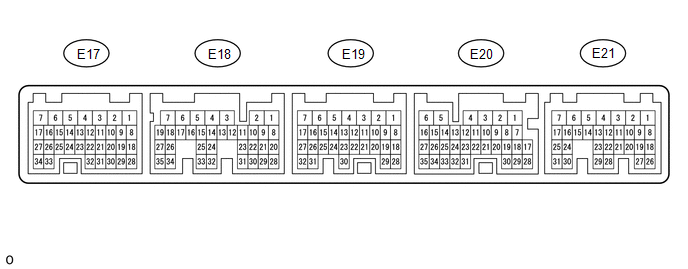
HINT:
The standard voltage between each pair of ECM terminals is shown in the table below. In the table, first follow the information under "Condition". Look under "Terminal No. (Symbol)" for the terminals to be inspected. The standard voltage between the terminals is shown under "Specified Condition".
Use the illustration above as a reference for the ECM terminals.
|
Terminal No. (Symbol) |
Wiring Color |
Terminal Description |
Condition |
Specified Condition |
|---|---|---|---|---|
|
E18-9 (SP2O) - E17-3 (E1) |
L - W-B |
Transmission revolution sensor (SP2) signal |
Vehicle driving |
Pulse generation |
|
E18-10 (SP2B) - E17-3 (E1) |
G - W-B |
Power source for sensor (fixed voltage) |
Ignition switch ON |
11 to 14 V |
|
E18-12 (SL) - E17-3 (E1) |
R - W-B |
Shift solenoid valve SL signal |
All gears |
11 to 14 V |
|
E18-15 (NSW) - E17-3 (E1) |
V - W-B |
Park/neutral position switch signal |
Ignition switch ON and shift lever in P or N |
Below 1 V |
|
Ignition switch ON and shift lever not in P or N |
11 to 14 V |
|||
|
E19-2 (SLU+) - E19-1 (SLU-) |
P - L |
Shift solenoid valve SLU signal |
2nd, 3rd, 4th, 5th or 6th gear (Flex lock-up on) |
Pulse generation |
|
E19-5 (SLT+) - E19-4 (SLT-) |
LG - Y |
Shift solenoid valve SLT signal |
Engine idling |
Pulse generation |
|
E19-7 (SL2+) - E19-6 (SL2-) |
GR - BE |
Shift solenoid valve SL2 signal |
4th, 5th or 6th gear |
Pulse generation |
|
E19-9 (SL1+) - E19-8 (SL1-) |
R - V |
Shift solenoid valve SL1 signal |
1st, 2nd, 3rd or 4th gear |
Pulse generation |
|
E19-13 (SL4+) - E19-12 (SL4-) |
SB - BE |
Shift solenoid valve SL4 signal |
3rd or 5th gear |
Pulse generation |
|
E19-16 (SL3+) - E19-15 (SL3-) |
B - W |
Shift solenoid valve SL3 signal |
2nd or 6th gear |
Pulse generation |
|
E19-17 (SFTU) - E17-3 (E1) |
SB - W-B |
Up-shift position switch signal |
Ignition switch ON and shift lever in S |
11 to 14 V |
|
Ignition switch ON and shift lever in "+" (Up-shift) |
Below 1 V |
|||
|
E19-19 (NTO) - E17-3 (E1) |
W - W-B |
Transmission revolution sensor (NT) signal |
Engine idling |
Pulse generation |
|
E19-20 (THO1) - E19-21 (ETHO) |
P - V |
No. 1 ATF temperature sensor signal |
No. 1 ATF temperature: 115°C (239°F) or higher |
Below 1.5 V |
|
E19-22 (THO2) - E19-21 (ETHO) |
L - V |
No. 2 ATF temperature sensor signal |
No. 2 ATF temperature: 115°C (239°F) or higher |
Below 1.5 V |
|
E19-24 (N) - E17-3 (E1) |
G - W-B |
N shift position switch signal |
Ignition switch ON and shift lever in N |
11 to 14 V |
|
Ignition switch ON and shift lever not in N |
Below 1 V |
|||
|
E19-25 (P) - E17-3 (E1) |
GR - W-B |
P shift position switch signal |
Ignition switch ON and shift lever in P |
11 to 14 V |
|
Ignition switch ON and shift lever not in P |
Below 1 V |
|||
|
E19-27 (SFTD) - E17-3 (E1) |
R - W-B |
Down-shift position switch signal |
Ignition switch ON and shift lever in S |
11 to 14 V |
|
Ignition switch ON and shift lever in "-" (Down-shift) |
Below 1 V |
|||
|
E19-29 (NTB) - E17-3 (E1) |
Y - W-B |
Power source for sensor (fixed voltage) |
Ignition switch ON |
11 to 14 V |
|
E19-30 (S) - E17-3 (E1) |
B - W-B |
S shift position switch signal |
Ignition switch ON and shift lever in S, "+" or "-" |
11 to 14 V |
|
Ignition switch ON and shift lever not in S, "+" or "-" |
Below 1 V |
|||
|
E20-8 (R) - E17-3 (E1) |
V - W-B |
R shift position switch signal |
Ignition switch ON and shift lever in R |
11 to 14 V |
|
Ignition switch ON and shift lever not in R |
Below 1 V |
|||
|
E20-13 (CANH) - E17-3 (E1) |
B - W-B |
CAN communication line |
Ignition switch ON |
Pulse generation |
|
E20-14 (CANL) - E17-3 (E1) |
W - W-B |
CAN communication line |
Ignition switch ON |
Pulse generation |
|
E20-18 (D) - E17-3 (E1) |
SB - W-B |
D shift position switch signal |
Ignition switch ON and shift lever in D, S, "+" or "-" |
11 to 14 V |
|
Ignition switch ON and shift lever not in D, S, "+" or "-" |
Below 1 V |
|||
|
E21-14 (PWMS) - E17-3 (E1) |
P - W-B |
Pattern select switch signal |
Ignition switch ON and pattern select switch pushed |
Below 1 V |
|
Ignition switch ON and pattern select switch not pushed |
11 to 14 V |
 Dtc Check / Clear
DTC CHECK / CLEAR
NOTICE:
When the diagnosis system is changed from normal mode to check mode or vice versa,
all DTCs and freeze frame data recorded in normal mode are cleared. Before changing
m ...
 Check Mode Procedure
CHECK MODE PROCEDURE
1. DESCRIPTION
(a) Check mode has a higher sensitivity to malfunctions and can detect malfunctions
that normal mode cannot detect. Check mode can also detect all the malfuncti ...
Other materials:
Installation
INSTALLATION
PROCEDURE
1. INSTALL FRONT NO. 2 SPEAKER ASSEMBLY RH
(a) Connect the connector.
(b) Install the front No. 2 speaker assembly RH with the 2 bolts.
Torque:
8.4 N·m {86 kgf·cm, 74 in·lbf}
NOTICE:
Do not touch the cone part of the front No. 2 speaker assembly RH.
...
Removal
REMOVAL
CAUTION / NOTICE / HINT
CAUTION:
Some of these service operations affect the SRS airbag system. Read
the precautionary notices concerning the SRS airbag system before servicing
(See page ).
If the side airbag was deployed, replace the front seat assembly with
a ne ...
Seatback table
Front passenger’s seatback can be used as a temporary table only when the
vehicle is stopped.
Fold down the front passenger’s seat to use the seatback table.
CAUTION
■Caution while driving
Observe the following precautions to avoid death or serious injury.
●Do not set up the ...
