REMOVAL
PROCEDURE
1. PRECAUTION
NOTICE:
After turning the ignition switch off, waiting time may be required before disconnecting the cable from the negative (-) battery terminal. Therefore, make sure to read the disconnecting the cable from the negative (-) battery terminal notices before proceeding with work.
Click here .gif)
2. RECOVER REFRIGERANT FROM REFRIGERATION SYSTEM
Click here
3. DISCONNECT CABLE FROM NEGATIVE BATTERY TERMINAL
NOTICE:
When disconnecting the cable, some systems need to be initialized after the cable is reconnected.
Click here
4. REMOVE RADIATOR ASSEMBLY (for 2TR-FE)
Click here
5. REMOVE RADIATOR ASSEMBLY (for 2GR-FKS)
Click here
6. DISCONNECT DISCHARGE HOSE SUB-ASSEMBLY
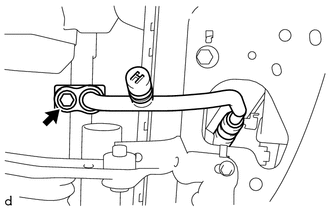
(a) Remove the bolt to disconnect the discharge hose sub-assembly from the cooler condenser assembly.
(b) Remove the O-ring from the discharge hose sub-assembly.
NOTICE:
Seal the openings of the disconnected parts using vinyl tape to prevent moisture and foreign matter from entering.
7. DISCONNECT AIR CONDITIONING TUBE ASSEMBLY
|
(a) Remove the bolt to disconnect the air conditioning tube assembly from the cooler condenser assembly. |
|
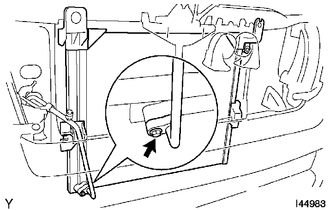
(b) Remove the O-ring from the air conditioning tube assembly.
NOTICE:
Seal the openings of the disconnected parts using vinyl tape to prevent moisture and foreign matter from entering.
8. REMOVE COOLER CONDENSER ASSEMBLY
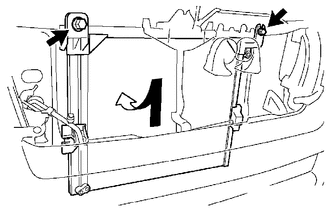
(a) Remove the 2 bolts.
(b) Lift the cooler condenser assembly up, disengage the fitting of the condenser lower bracket to remove the cooler condenser assembly from the rear side of the vehicle.
|
(c) Disengage the 2 claws to remove the 2 condenser upper brackets. |
|
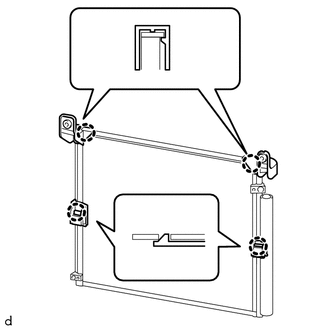
(d) Disengage the 2 claws to remove the 2 condenser lower brackets.
(e) Remove the cooler condenser assembly.
HINT:
At the time of installation, please refer to the following instructions. If installing a new condenser, add compressor oil to the condenser.
Compressor oil:
PSD1 or equivalent
Add 40 cc (1.4 fl.oz.)

