Replacement
REPLACEMENT
PROCEDURE
1. REMOVE NO. 2 ENGINE UNDER COVER SUB-ASSEMBLY (w/ Off Road Package)
2. REMOVE NO. 1 ENGINE UNDER COVER SUB-ASSEMBLY
3. DRAIN ENGINE COOLANT
CAUTION:
- Do not remove the radiator cap sub-assembly, cylinder block drain cock plug or radiator drain cock plug while the engine and radiator assembly are still hot. Pressurized, hot engine coolant and steam may be released and cause serious burns.
- To prevent injury due to contact with an operating fan and generator V belt or cooling fan, keep your hands and clothing away from the fan and generator V belt and cooling fans when working in the engine compartment with the engine running.
- When pressing the radiator hoses, wear protective gloves.
HINT:
Before starting the engine to warm up the engine, turn the A/C switch off.
|
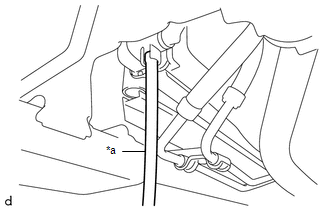
(a) Connect a hose with an inside diameter of 9 mm (0.354 in.) to the radiator drain cock as shown in the illustration. Text in Illustration
|
|
(b) Loosen the radiator drain cock plug.
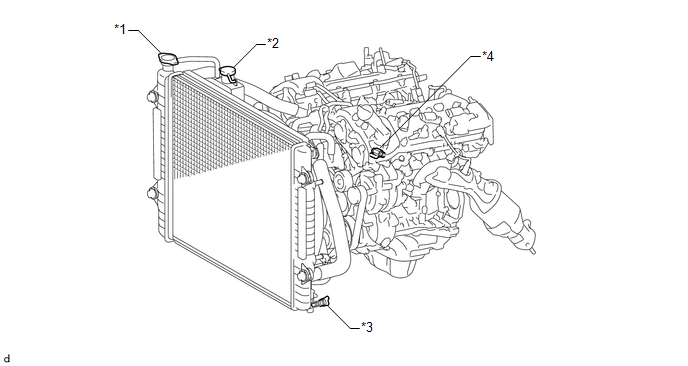 Text in Illustration
|
*1 |
Radiator Cap Sub-assembly |
*2 |
Reserve Tank Cap Sub-assembly |
|
*3 |
Radiator Drain Cock Plug |
*4 |
Cylinder Block Drain Cock Plug |
(c) Remove the radiator cap sub-assembly and drain the engine coolant.
HINT:
Collect the engine coolant in a container and dispose of it according to the regulations in your area.
(d) Loosen the cylinder block drain cock plug and drain the engine coolant.
(e) Tighten the cylinder block drain cock plug.
Torque:
13 N·m {130 kgf·cm, 9 ft·lbf}
(f) Tighten the radiator drain cock plug by hand.
(g) Remove the hose from the radiator drain cock.
4. ADD ENGINE COOLANT
(a) Add engine coolant.
Standard Capacity:
|
Item |
Specified Condition |
|
|---|---|---|
|
for Automatic Transmission |
w/ Engine Oil Cooler |
10.5 liters (11.1 US qts, 9.2 Imp. qts) |
|
w/o Engine Oil Cooler |
9.9 liters (10.5 US qts, 8.7 Imp. qts) |
|
|
for Manual Transmission |
w/ Engine Oil Cooler |
10.2 liters (10.8 US qts, 9.0 Imp. qts) |
|
w/o Engine Oil Cooler |
9.6 liters (10.1 US qts, 8.4 Imp. qts) |
|
NOTICE:
Do not substitute plain water for engine coolant.
HINT:
TOYOTA vehicles are filled with TOYOTA SLLC at the factory. In order to avoid damage to the engine cooling system and other technical problems, only use TOYOTA SLLC or similar high quality ethylene glycol based non-silicate, non-amine, non-nitrite, non-borate coolant with long-life hybrid organic acid technology (coolant with long-life hybrid organic acid technology is a combination of low phosphates and organic acids).
(b) Press the No. 1 radiator hose and No. 2 radiator hose several times by hand, and then check the engine coolant level. If the engine coolant level is low, add engine coolant.
(c) Remove the reserve tank cap sub-assembly.
(d) Slowly pour engine coolant into the radiator reservoir tank until it reaches the FULL line.
(e) Install the reserve tank cap sub-assembly.
(f) Bleed air from the cooling system.
(1) Warm up the engine until the thermostat opens. While the thermostat is open, circulate the engine coolant for several minutes.
NOTICE:
- Immediately after starting the engine, if the radiator reservoir tank does not have any engine coolant, perform the following: 1) stop the engine, 2) wait until the engine coolant has cooled down, and 3) add engine coolant.
- Do not start the engine when there is no engine coolant in the radiator reservoir tank.
- Make sure that the needle does not show an abnormally high temperature.
- If there is not enough engine coolant, the engine may overheat.
HINT:
The thermostat open timing can be confirmed by pressing the No. 2 radiator hose by hand, and checking when the engine coolant starts to flow inside the hose.
(2) Maintain the engine speed at 2000 to 2500 rpm.
(3) Press the No. 1 radiator hose and No. 2 radiator hose several times by hand to bleed air.
(g) Stop the engine, and wait until the engine coolant cools down to ambient temperature.
(h) Check the engine coolant level in the radiator reservoir tank.
If the engine coolant level is low, add engine coolant to the radiator reservoir tank FULL line.
5. INSPECT FOR COOLANT LEAK
.gif)
6. INSTALL NO. 1 ENGINE UNDER COVER SUB-ASSEMBLY
Torque:
30 N·m {306 kgf·cm, 22 ft·lbf}
7. INSTALL NO. 2 ENGINE UNDER COVER SUB-ASSEMBLY (w/ Off Road Package)
Torque:
30 N·m {306 kgf·cm, 22 ft·lbf}