SYSTEM DESCRIPTION
1. FRONT PASSENGER OCCUPANT CLASSIFICATION SYSTEM
(a) General Description
(1) The front passenger occupant detection ECU determines whether the front passenger seat is occupied by an adult or child (with child seat) or is unoccupied, based on the load that is applied to the front passenger seat and whether the seat belt is buckled. The system restricts the deployment of the front passenger airbag, front passenger side airbag, and the front passenger seat belt pretensioner in accordance with this judgment. The result is informed to the driver through the airbag ON/OFF indicator illumination.
(b) System Configuration
(1) This system consists of the occupant detection ECU, occupant classification sensors, airbag ON/OFF indicator, seat belt buckle switches, and airbag sensor assembly.
(c) Occupant Detection ECU and Sensor
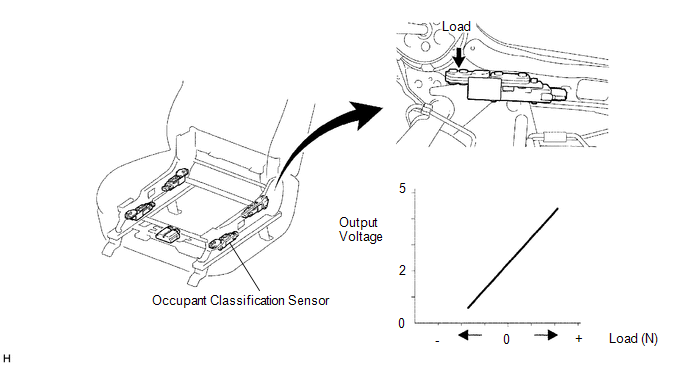
(1) The occupant classification sensors are installed on four brackets connecting the seat rail and the seat frame. The resistance values of these sensors, which vary in accordance with the load that acts on the brackets, are transmitted to the occupant detection ECU as signals. Upon receipt of the signals, the ECU determines the front passenger seat occupant conditions.