DESCRIPTION
The brake fluid level warning switch sends the appropriate signal to the skid control ECU (master cylinder solenoid) when the brake fluid level drops.
|
DTC Code |
DTC Detection Condition |
Trouble Area |
|---|---|---|
|
C1453 |
With the ECU terminal IG1 voltage at 10 to 14 V, an open in the brake fluid level warning switch circuit continues for 2 seconds or more. |
|
|
C1454 |
The fluid level of the reservoir is LOW for 40 seconds after the ignition switch is turned to ON, or for 7 seconds during pump motor operation. |
WIRING DIAGRAM
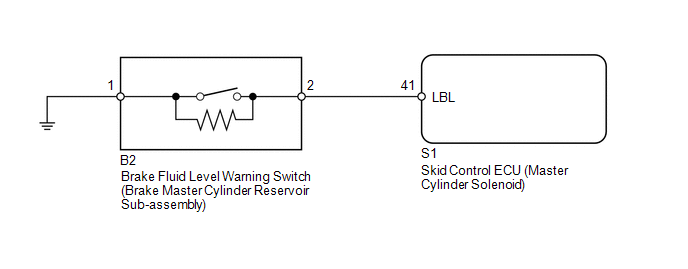
CAUTION / NOTICE / HINT
NOTICE:
When replacing the skid control ECU (master cylinder solenoid), perform calibration
(See page .gif) ).
).
PROCEDURE
|
1. |
CHECK BRAKE FLUID LEVEL |
(a) Turn the ignition switch off.
(b) Depress the brake pedal 40 times or more (until the pedal reaction feels light and pedal stroke becomes longer).
(c) Check the amount of fluid in the brake reservoir.
HINT:
When the ignition switch is turned to ON, brake fluid is sent to the accumulator and the fluid level decreases by approximately 5 mm (0.197 in.) from the level when the ignition switch is off (normal).
OK:
Brake fluid level is normal.
| NG | .gif) |
CHECK AND REPAIR BRAKE FLUID LEAKAGE |
|
.gif)
|
2. |
INSPECT BRAKE FLUID LEVEL WARNING SWITCH |
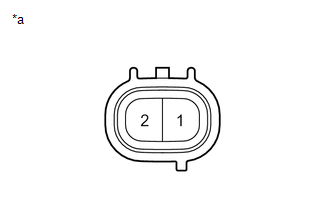
(a) Disconnect the B2 brake fluid level warning switch (brake master cylinder reservoir sub-assembly) connector.
|
(b) Measure the resistance according to the value(s) in the table below. HINT: A float is placed inside the reservoir. Its position can be changed by increasing/decreasing the level of brake fluid. Standard Resistance:
HINT: If there is no problem after finishing the above check, adjust the brake fluid level to the MAX level. |
|
| NG | |
REPLACE BRAKE MASTER CYLINDER RESERVOIR SUB-ASSEMBLY |
|
|
3. |
CHECK HARNESS AND CONNECTOR (SKID CONTROL ECU - BRAKE FLUID LEVEL WARNING SWITCH) |
(a) Disconnect the S1 skid control ECU (master cylinder solenoid) connector.
(b) Disconnect the B2 brake fluid level warning switch (brake master cylinder reservoir sub-assembly) connector.
(c) Measure the resistance according to the value(s) in the table below.
Standard Resistance:
|
Tester Connection |
Condition |
Specified Condition |
|---|---|---|
|
S1-41 (LBL) - B2-2 |
Always |
Below 1 Ω |
|
S1-41 (LBL) - Body ground |
Always |
10 kΩ or higher |
|
S1-41 (GND) - Body ground |
Always |
Below 1 Ω |
| NG | |
REPAIR OR REPLACE HARNESS OR CONNECTOR |
|
|
4. |
RECONFIRM DTC |
(a) Clear the DTCs (See page
).
(b) Turn the ignition switch off.
(c) Start the engine and idle it for approximately 40 seconds.
(d) Check if the same DTCs are output (See page
).
|
Result |
Proceed to |
|---|---|
|
DTC is output |
A |
|
DTC is not output |
B |
| A | |
REPLACE MASTER CYLINDER SOLENOID |
| B | |
USE SIMULATION METHOD TO CHECK |

