Components
COMPONENTS
ILLUSTRATION
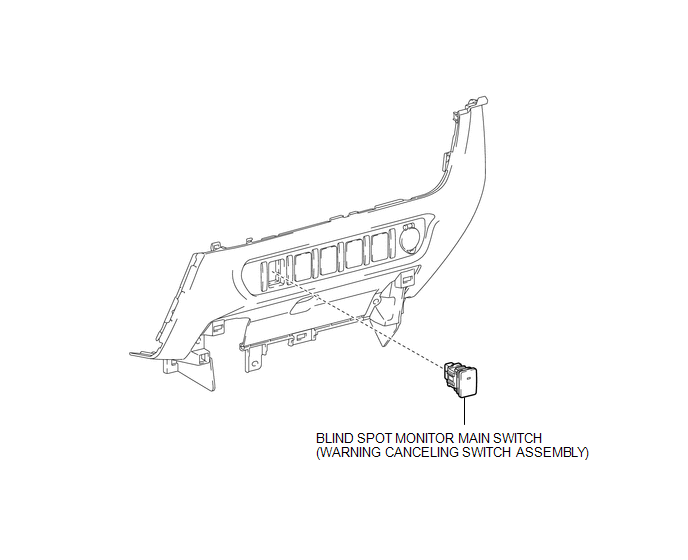
Removal
REMOVAL
PROCEDURE
1. REMOVE INSTRUMENT PANEL LOWER CENTER FINISH PANEL
(See page .gif) )
)
2. REMOVE BLIND SPOT MONITOR MAIN SWITCH (WARNING CANCELING SWITCH ASSEMBLY)
|
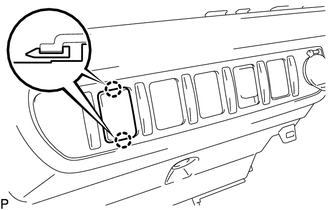
(a) Disengage the 2 claws to remove the blind spot monitor main switch (warning canceling switch assembly). |
|
Inspection
INSPECTION
PROCEDURE
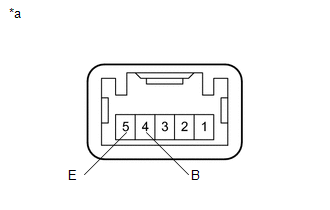
1. INSPECT BLIND SPOT MONITOR MAIN SWITCH (WARNING CANCELING SWITCH ASSEMBLY)
|
(a) Measure the resistance according to the value(s) in the table below. Text in Illustration
Standard Resistance:
If the result is not as specified, replace the blind spot monitor main switch (warning canceling switch assembly). |
|
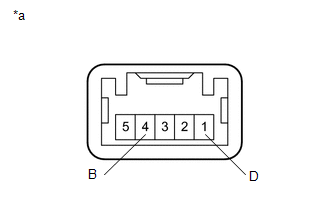
(b) Check that the switch illuminates.
|
(1) Apply battery voltage to the blind spot monitor main switch (warning canceling switch assembly) and check that the switch illuminates. Text in Illustration
OK:
If the result is not as specified, replace the blind spot monitor main switch (warning canceling switch assembly). |
|
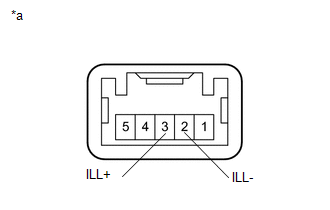
(c) Check that the switch indicator operates.
|
(1) Apply battery voltage to the blind spot monitor main switch (warning canceling switch assembly) and check that the switch indicator operates. Text in Illustration
OK:
If the result is not as specified, replace the blind spot monitor main switch (warning canceling switch assembly). |
|
Installation
INSTALLATION
PROCEDURE
1. INSTALL BLIND SPOT MONITOR MAIN SWITCH (WARNING CANCELING SWITCH ASSEMBLY)
(a) Engage the 2 claws to install the blind spot monitor main switch (warning cancel switch assembly).
2. INSTALL INSTRUMENT PANEL LOWER CENTER FINISH PANEL
(See page .gif) )
)