CHECK MODE PROCEDURE
1. DESCRIPTION
Check mode has a higher sensitivity to malfunctions and can detect malfunctions that cannot be detected in normal mode. Check mode can also detect all of the malfunctions that can be detected in normal mode. In check mode, DTCs are stored with 1 trip detection logic.
NOTICE:
- All DTCs and freeze frame data will be cleared if: 1) the Techstream is used to change the ECM from normal mode to check mode or vice versa; or 2) during check mode, the ignition switch is turned from ON to ACC or off.
- Before changing to check mode, make a note of the DTCs and freeze frame data.
2. CHECK MODE PROCEDURE
(a) Make sure that the following conditions are met:
(1) Battery voltage is 11 V or higher.
(2) The throttle valve is fully closed.
(3) The shift lever is in neutral.
(4) The A/C switch is off.
(b) Connect the Techstream to the DLC3.
(c) Turn the ignition switch to ON.
(d) Turn the Techstream on.
(e) Enter the following menus: Powertrain / Transmission / Utility / Check Mode.
(f) Check that the MIL flashes as shown in the illustration.
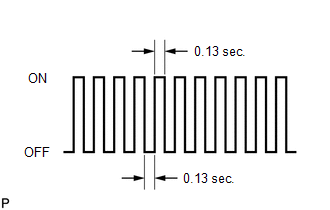
(g) Start the engine. The MIL should turn off after the engine starts.
(h) Simulate the conditions of the malfunction described by the customer.
(i) Using the Techstream, check for DTCs and freeze frame data.